|
This week, the United States acknowledged the 60th anniversary of the Voting Rights Act. Signed into law by Texan Lyndon Baines Johnson, the VRA outlawed the discriminatory voting practices adopted in many southern states after the Civil War. Ironically, Texas lawmakers spent the week debating proposed congressional district maps that would undo important aspects of that progress.
The Texas House has not been able to conduct some parts of its business because a quorum of members has not been present. Fifty-one Democrat House members have left the state to prevent the House from considering HB4, the proposed new congressional district maps. The move, known as “breaking quorum,” is legal, but under the House rules, members who break quorum can be penalized. Legislators who break quorum are not absent from their elected positions—they only are absent from the House floor.
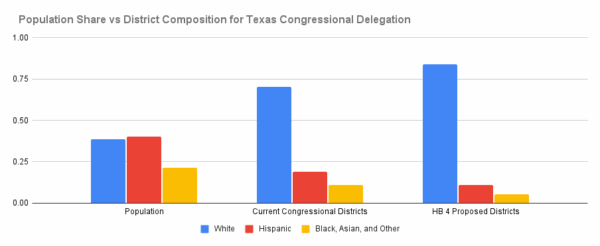
House Democrats have chosen to break quorum because, given the partisan makeup of the House, it is a virtual certainty that the maps will pass if there is a vote. The new maps are designed to increase the share of Republican-leaning congressional districts in Texas—but, while partisan redistricting is legally permissible, the proposed maps also have impermissible implications for minority communities.
The author of HB4 says that the proposed maps are drawn to achieve partisan purposes but without consideration to racial implications. However, the maps intentionally reduce the number of African American opportunity districts, which would violate Section 2 of the Voting Rights Act.
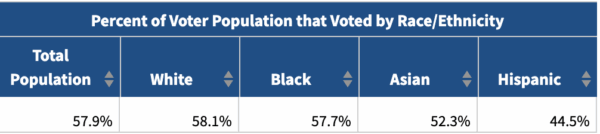
Furthermore, the author of HB4 points out that the five newly Republican districts have been drawn as majority-Hispanic districts, based on each district’s Hispanic CVAP (citizens of voting age population). However, CVAP is not a predictor of voter turnout, and Hispanic citizens of voting age have the lowest voter turnout of any race/ethnic group in Texas. |