|
Dear {name},
This week, the House Public Education Committee passed its committee substitute for SB 2, this session’s school voucher bill, as well as its committee substitute for HB 2, which would provide a modest increase in funding to public schools. As is customary, the committee met in a “formal meeting” to vote out pending bills, so it was not required to livestream the meeting, although several members of the committee objected vigorously to the lack of livestream.
Normally, formal meetings are very short, but in this case the meeting lasted more than 2 ½ hours and featured contentious discussion of substantive changes in the committee substitutes that constituents would want to understand. While media and nonprofit organizations posted video clips from the meeting, they do not provide a full picture of the bill. The texts of the committee substitutes are not yet available publicly on the Capitol website.
Texas Impact has posted the complete audio recording of the meeting, together with a transcript of the recording. We also have posted the committee substitutes for HB 2 and SB 2.
SB 2 Transcript
SB 2 Audio
Committee Substitute for Senate Bill 2
HB 2 Transcript
HB 2 Audio
Committee Substitute for House Bill 2
Legislators spoke eloquently about the need for public school funding; the irresponsibility of providing publicly funded vouchers without accountability or transparency; and the questionable math underlying budget assumptions in the voucher bill.
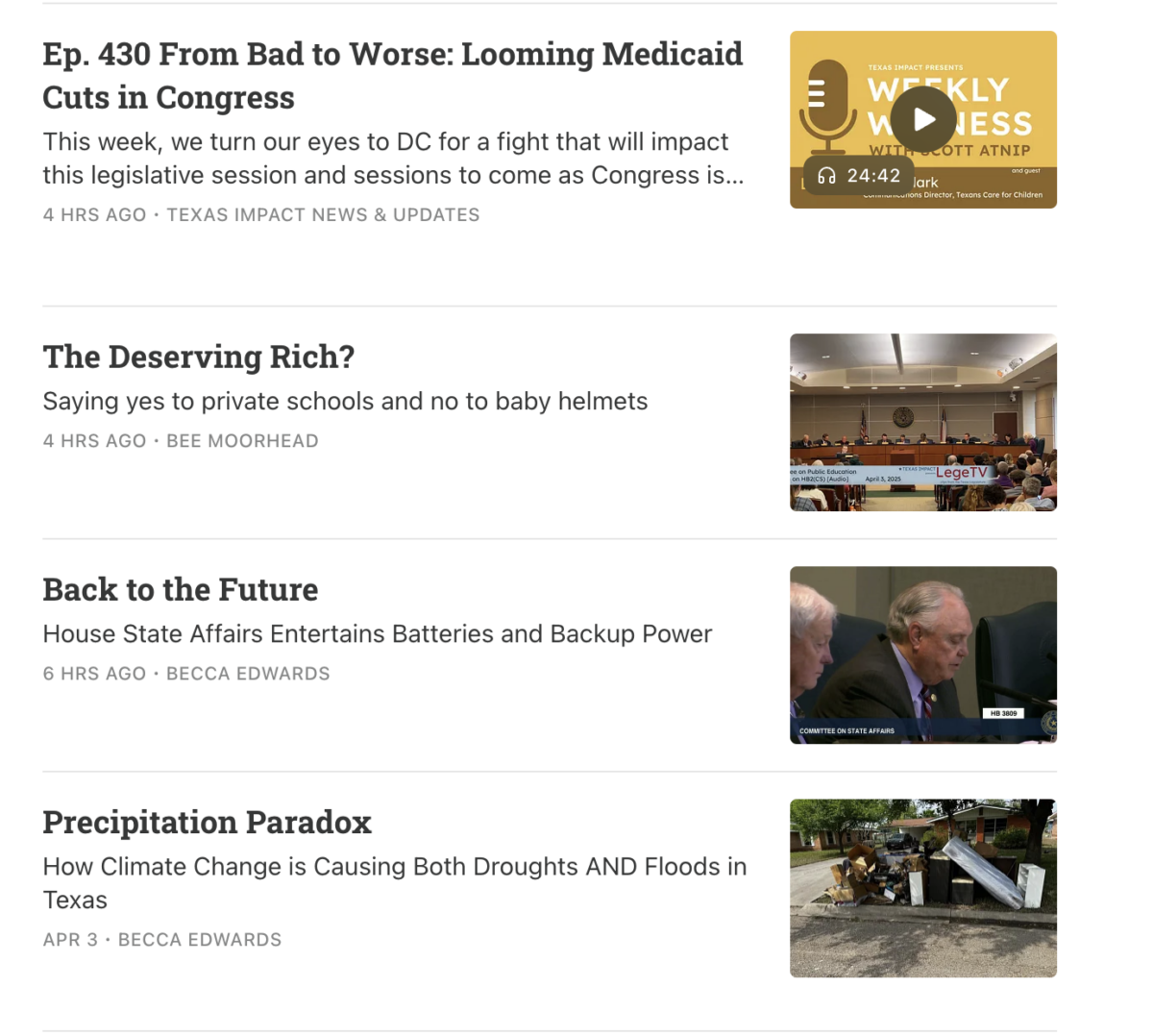
In his final comments, the committee’s vice-chair, Rep. Diego Bernal, said the injustice of the voucher proposal is "hard to swallow:"
For eight years I've been trying to pass a bill that would have Medicaid cover the cost of baby helmets. And for all those eight years I've been told “no.” And the reason, I've been told, is this fear that somehow some black-market cottage industry will be created where these things are overprescribed and kids who don't need it will get it. And yet 20% of the [voucher] bill is reserved for people that we already know don't need it.
Also this week, the House State Affairs Committee heard several forward-looking bills that would facilitate the rollout of battery energy storage systems and home backup power in Texas. Becca writes about the importance of battery storage as a part of a comprehensive renewable energy strategy. Becca also writes about climate impacts on extreme water events—both droughts and floods. As legislators consider major wildfire mitigation legislation and historic water investments, it would be wise to consider how decisions across a wide range of policy areas contribute to the climate impacts underlying many of our state’s challenges.
I spent much of this week in another climate-impacted state—Florida—at the annual meeting of directors of Lutheran State Public Policy Offices (SPPOs). Texas Impact serves as our state’s SPPO, one of several interfaith organizations holding this role in their respective states. The meeting was a good reminder that faith-based advocates in states across the country—whether red, blue, or purple—are meeting challenges at the state and federal levels. We can learn from each others’ good practices, and draw strength from our shared faith and values.
One issue all the SPPOs are working on right now is resisting federal Medicaid cuts. On the latest episode of Weekly Witness, Scott talks with Texans Care for Children’s Peter Clark about the catastrophic impacts Medicaid cuts would have in Texas.
Urge your member of Congress to say no to Medicaid cuts
It’s good to know we have colleagues around the country, and we hope you know that you have advocacy colleagues all over Texas. Wondering who else in your local area is active with Texas Impact? Let us know and we’ll help you make those connections!
Love, |