|
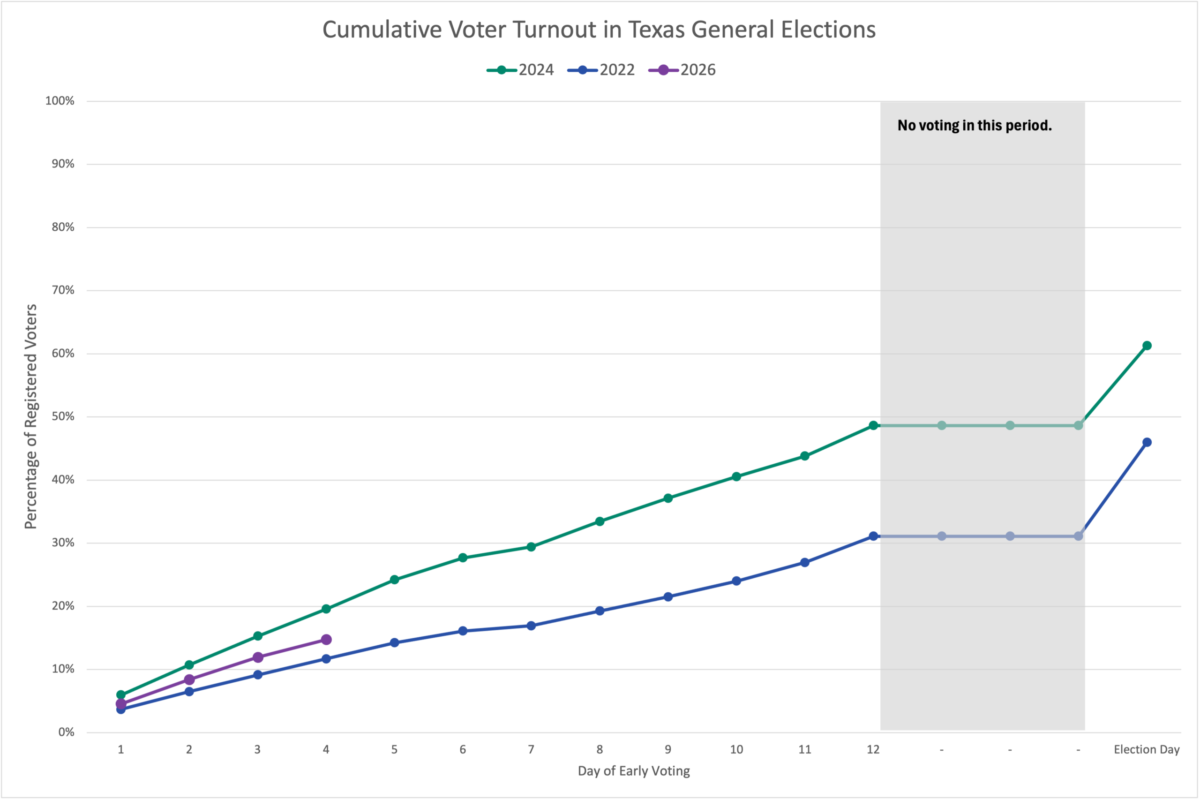
This week, early voting started in Texas for the midterm elections. For candidates, the early voting period is a last chance to influence voters who haven’t cast ballots yet. For voters, it’s either the final opportunity to gain insights before choosing between candidates or a time to reflect on new information that comes to light after you’ve already voted. (I was visiting family this week in Ohio, where early voting started on October 6.)
Organizations across the political spectrum are urging Texans to vote early. Lt. Governor Dan Patrick is calling on Republicans specifically to vote early. The League of Women Voters is characterizing Saturday, October 24 as “Vote Early Day,” and a number of Texas Black church leaders have dubbed Sunday, October 25 “Black Out Sunday,” challenging their churches to achieve 100% turnout of their eligible voters. Learn more about Black Out Sunday in this week's episode of Weekly Witness.
Texas Impact urged Texans to Be a Day One Voter—and many Texans seem to have adopted the strategy, with Dallas, Harris, and other large counties breaking records for early voting on the first day. (As of October 20, Jeff Davis County had the highest turnout of any Texas county at more than 27 percent.)
For organizations like Texas Impact that focus primarily on legislative policy, the election period functions as a particular kind of liminal space. Spiritually, liminal space is a sacred location, a threshold between what was and what will be that Richard Rohr describes as “a good space where genuine newness can begin.” For anyone trying to get a jump on the legislative session, the liminal space of early voting is a location where our fondest policy goals, strategies, hopes, and expectations all are theoretically possible—as are our worst nightmare scenarios.
Read the whole post |