|
This week, we started a war, held primary elections, and experienced a mass shooting in Austin.
Before you say “What WE? I didn’t start a war,” recall that all three of those events were made possible through public policy, and public policy implicates the entire community. Texas Impact members are deeply involved in public policy all the time and at all levels. It can be really frustrating to do the work but not see the results we hope for.
That’s why this week represents an important inflection point. Let’s talk about it.
National leaders are offering diverse explanations of the war: why we are involved, how the decisions are being made, and what it will mean for our communities in the coming weeks. But there seems to be broad agreement that Americans don’t want to get sucked into another “forever war” in the Middle East. As Becca, Bobby, and Dylan write in an epic Substack post, it’s also clear that the war is part of an accelerating feedback loop in which conflict destabilizes the climate, and climate change in turn acts as a “threat multiplier” leading to escalating conflict around the world.
It’s tempting to attend rallies with cleverly worded signs protesting the war, but that’s probably not the most efficacious choice. This week I listened to an interview with Charles Duhigg, author of Supercommunicators, about his recent article in The New Yorker on differences in how Democrats and Republicans organize themselves.
I didn’t resonate with every single one of Duhigg’s observations, but I agreed with a lot of them and I learned a lot. I’ll be spending time over the next few weeks considering how Texas Impact’s work reflects Duhigg’s analysis—the good parts and the bad parts. I’d love to hear from you about your observations. Because the underlying issue is not which political faction communicates better or has better policies. It’s about how we cultivate the communication habits that help our entire community participate effectively in public policy development to advance the common good.
Texas Impact’s network has been working very intentionally on communication in the area of voter engagement, and this week we got some important affirmation of that approach. As Rebecca writes on Substack, voter turnout for this primary was the highest in recent history. And, while Texas faith communities can’t take all the credit, anecdotal evidence suggests that congregations played a key role:
Our civic engagement work is based on the belief that people want to learn and enabling trusted messengers works. When presenting to a major industry association, an exec of a major energy company said: “I know March Matters, I’ve heard sermons on it for the past two weeks at my church in Houston.”
- Marjorie Clifton, co-founder of March Matters
The election also highlighted a couple of vital next steps for Texas faith communities.
First, we know there was confusion about polling locations in Dallas. Going forward, it’s crucial that local voter engagement teams know their local election administrators—and that means really know, not just know their names. The American election system relies on voluntary relationships based on trust and common purpose. It’s not realistic to imagine those relationships spring fully formed or self-sustained. They depend on authentic interpersonal connections. (Charles Duhigg has a lot to say about authentic communication.)
Second, we know Texas will be under a national microscope for the remainder of this election cycle. It’s often fun to be in the spotlight, but it comes with challenges. Texas congregations will be courted by advocacy groups, local coalitions, campaigns, and others as “trusted messengers” to advance issues and to support candidates. Texas Impact has resources to help congregations and their leaders navigate election-season waters, and we’ll be providing more resources as the season heats up.
So, the shooting.
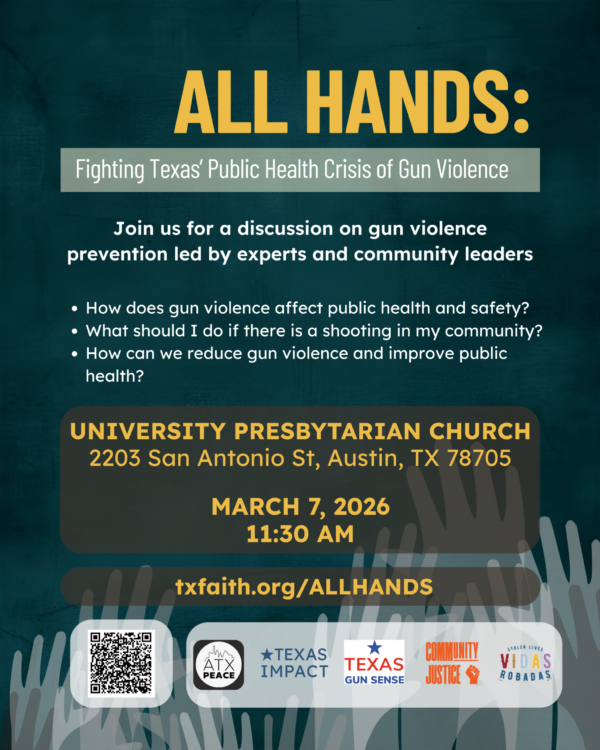
Bobby and Dylan wrote a post about it, in which they explain the “all-hands” approach necessary to address violence as a public health crisis. Texas Impact’s All Hands event series kicks off this weekend in Austin at University Presbyterian Church—registration is lovely (but not required), and there is no charge to attend.
The shooting hit me in a particular way because of a social media post I happened to read from Texas Impact’s Americorps VISTA alumna Selena Xie, who was the EMS transport commander on scene at the shooting. Selena came to Texas Impact as a funny, enthusiastic twenty-something who was interested in disaster response, and she has grown into a recognized emergency management leader in Central Texas.
Selena is one of dozens of Texas Impact alumni who are serving their communities as clergy, as policy experts, and as public servants. It’s a privilege to help shape the careers of people who will be the next generation of civic and political leaders in our state and nation.
We couldn’t do any of the work we do, including cultivating future leaders and resourcing current ones, without support from our members. If you have been participating in Texas Impact but haven’t taken the step of joining as a member, please know two things:
- We value you and your participation infinitely and we are totally committed to providing you with the best resources and opportunities we have to offer.
- We depend on member support to be able to provide those resources and opportunities, and we hope you’ll consider chipping in whatever you can afford toward our collective work.
Joining Texas Impact is easy and painless. Also Kat will send you a handwritten thank-you note! Seriously, how often do you get a handwritten note these days?
Whether you are a paid member, an enthusiastic participant, or even a casual observer, we are grateful to be in community with you. |